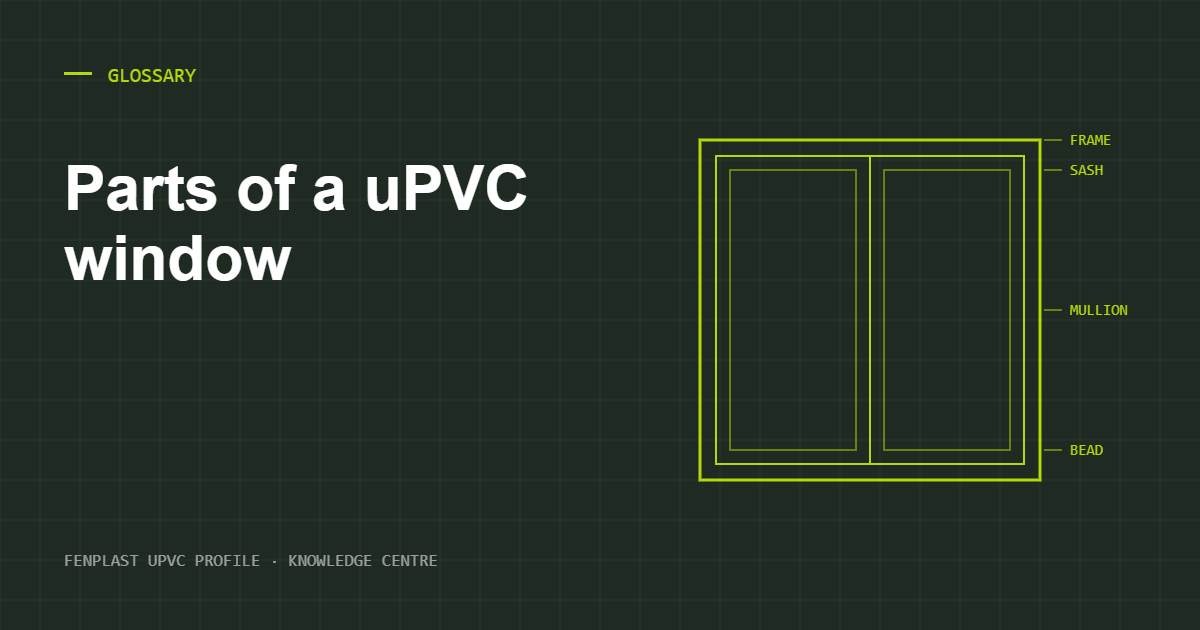
A uPVC window is built from extruded profiles: the frame (fixed outer border), the sash (the moving shutter), the mullion or transom (dividers), the glazing bead (holds the glass), and, in sliders, the interlock (seals meeting shutters). Inside, galvanised steel reinforcement adds strength and gaskets seal the glass and sash.
uPVC windows are assembled from long extruded sections called profiles. Each profile has a specific job. Once you know the names, quotations, drawings and fabricator conversations make much more sense. We've used Fenplast part codes as examples so you can see each part in our catalogue.
Frame
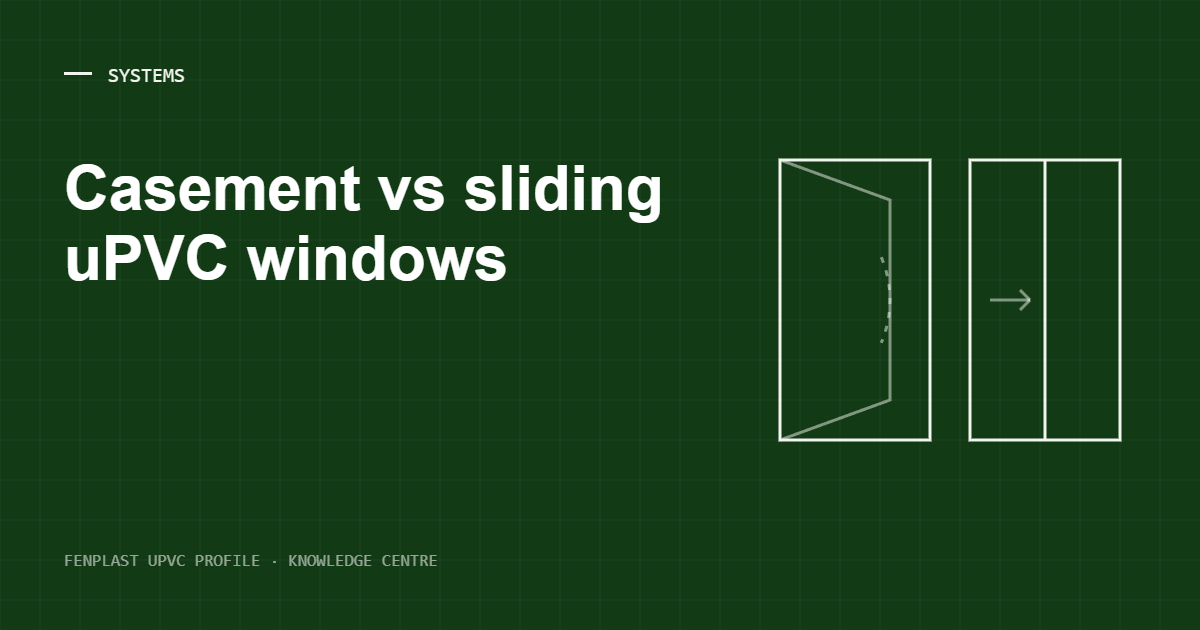
The fixed outer border of the window, anchored to the wall. Everything else sits inside it. Frames differ between window types: sliding frames have tracks; casement frames have a rebate for the sash to close against.
Examples: FEN-SF-001 2 track sliding frame, FEN-CF-011 casement frame, FEN-CDF-042 casement door frame.
Sash
The moving part — the shutter that slides or swings and holds the glass. In India, "shutter" and "sash" are often used interchangeably.
Examples: FEN-SS-005 sliding 66 sash, FEN-CS-012 casement sash, FEN-CS-014 casement door sash.
Mullion and transom
A mullion is a profile that divides a frame vertically, creating two or more sections — for instance, an openable sash next to fixed glass. When the same profile runs horizontally, it is called a transom. Example: FEN-CM-013 mullion.
Glazing bead
A slim profile that clips into the sash or frame to hold the glass in place. It goes on the inside, so glass can't be removed from outside. Beads come in sizes to suit single glass or thicker double-glazed units.
| Bead | Use |
|---|---|
| FEN-SB-008 | Sliding sash, single glass |
| FEN-AO-017 | Sliding sash, double glazing |
| FEN-CB-015 | Casement, single glass |
| FEN-AO-016 | Casement, double glazing |
Interlock
On sliding windows, an interlock is an add-on profile fitted to the meeting edges of two shutters so they hook together when closed. It blocks wind, rain and dust at the centre and stiffens the closed window. Windows use FEN-SI-009; doors use the taller FEN-SI-010.
Mesh sash
A lightweight sash that holds insect mesh instead of glass, running on its own track in 2.5 or 3 track windows. Examples: FEN-MS-007, FEN-MS-007(A).
Track
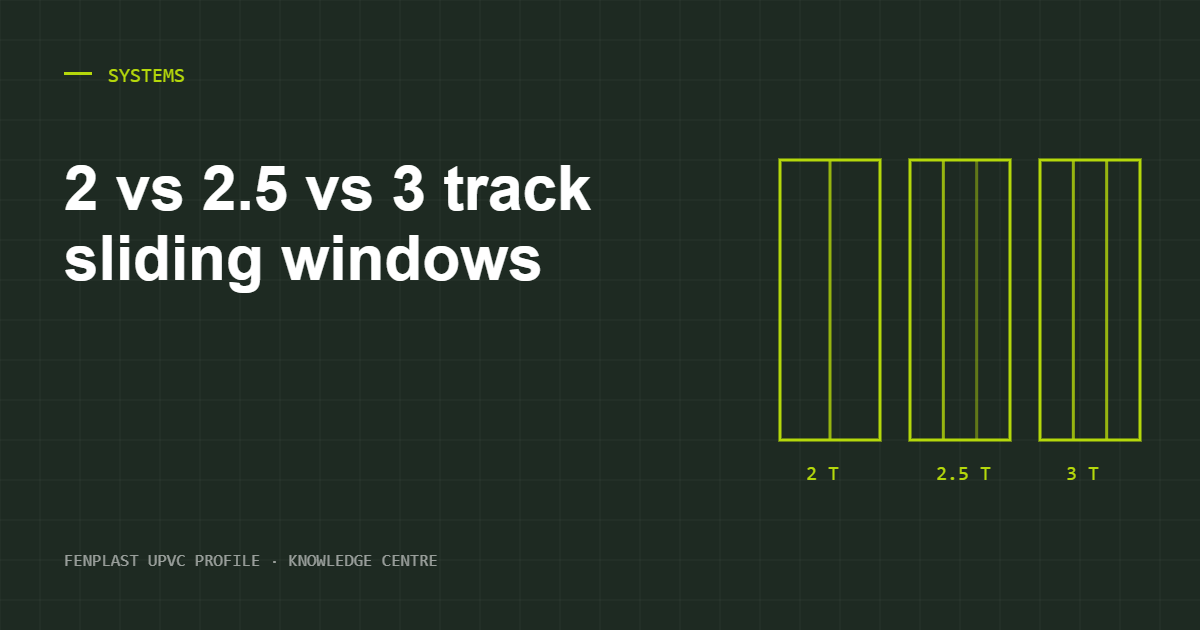
A rail in a sliding frame on which a shutter runs. A 2 track frame has two; a 2.5 track frame adds a narrow mesh track; a 3 track frame has three. See our track comparison.
Chamber
Hollow compartments inside a profile. Multi-chamber design adds stiffness, traps air for insulation, and separates functions: one chamber for drainage, one for screws, one for steel reinforcement.
Reinforcement
Galvanised steel sections inserted into the main chamber of frames and sashes before welding. Reinforcement is needed on larger windows, doors, mullions and windy elevations. Fenplast supplies casement and sliding reinforcement to suit its profiles.
Gasket
Rubber or TPE strips fitted into grooves in the profile. Glazing gaskets cushion and seal the glass; sash gaskets seal the gap between sash and frame on casements.
Weld and corner cleaning
uPVC frames and sashes are joined by heating mitred ends and pressing them together — fusion welding. The excess bead is then removed by corner cleaning for a neat finish and, on sliders, a smooth track.
Drainage slots
Small slots routed in the outer face of frames so water that gets onto the track can escape outside. Blocked or missing drainage is a common cause of "leaking windows".
Rebate
A stepped recess in a profile into which glass, a sash or a bead fits.
Euro groove
A standardised groove in casement profiles that accepts common hinges, friction stays and locking hardware.
Square post and T-connector
Coupling profiles. A square post (FEN-AO-019) joins frames at corners or in bay windows; a T-connector (FEN-AO-020) joins frames side by side.
Ventilator frame and louver bead
Profiles for small bathroom and kitchen ventilators: FEN-AO-018 frame and FEN-AO-022 louver bead.
Door panel
Interlocking uPVC panels that fill a door leaf instead of glass, popular for bathroom doors: FEN-AO-021.
DGU (double glazed unit)
Two panes of glass separated by a sealed spacer, improving heat and sound insulation. DGUs need slimmer beads because the glass package is thicker.
Bundle
The packing unit for profiles — a counted number of full-length bars. Fenplast bundle quantities range from 2 (112 mm three-track frame) to 40 (T-connector).
Putting it together
A typical Fenplast casement window: frame FEN-CF-011 with steel reinforcement, sash FEN-CS-012 with reinforcement, gaskets in the frame and sash, glass held with bead FEN-CB-015, hinges and lock in the Euro groove. Add mullion FEN-CM-013 and you have a casement with fixed glass.
Reading a uPVC window quotation
A detailed quotation from a fabricator often lists items like this. Here's how to read it:
| Line item | Meaning |
|---|---|
| W1 — 1200 × 1200 — 2.5T SL — 5 mm clear | Window 1, size in mm, 2.5 track slider, 5 mm clear glass |
| Profile: Fenplast SF-002 / SS-005 / MS-007(A) | Frame, glass sash and mesh sash part codes |
| Reinforcement: GI | Galvanised iron/steel inside profiles |
| Hardware: SS rollers, multi-point lock | Stainless rollers and locking type |
| Mesh: FG / SS | Fibreglass or stainless mesh |
| Rate per sq ft | Price basis — check what's included |
Profile part-code logic at Fenplast
Fenplast part codes are designed to be read at a glance: FEN for the brand, then a two- or three-letter type code, then a number.
- SF — sliding frame
- SS — sliding sash
- MS — mesh sash
- SB — sliding bead
- SI — sliding interlock
- CF / CDF — casement frame / casement door frame
- CS / CIS — casement sash / casement inward sash
- CM — casement mullion
- CB — casement bead
- AO — accessories and others
Hardware terms
Friction stay — a hinge mechanism that holds a casement open at any angle. Multi-point lock — a lock that engages at several points along the sash edge. Roller — wheels under a sliding sash. Keep — the part on the frame that the lock engages. Restrictor — limits how far a sash can open, for safety.
Installation terms
Anchoring / fastening — fixing the frame to the wall with fastener screws or frame anchors. Packing — shims placed under and around the frame to set it plumb and level. Perimeter sealing — silicone sealant applied between frame and wall to keep water and air out. Sill — the bottom ledge of the opening, ideally sloped outward. Plumb and level — vertical and horizontal accuracy, checked with tube and spirit levels. Diagonal check — measuring both diagonals of an opening or frame; equal diagonals mean it's square.
Glass terms
Clear glass — standard float glass. Toughened glass — heat-treated for strength and safety; breaks into small pieces. Laminated glass — two panes bonded with an interlayer; holds together when broken and helps with sound. Reflective / solar-control glass — reduces heat gain on sunny elevations. Frosted glass — obscured for bathroom privacy.
With these terms, you can read any window drawing or quotation with confidence. For a complete list of Fenplast profiles, see the uPVC profiles catalogue.
Frequently asked questions
What is the difference between a frame and a sash?
The frame is fixed to the wall; the sash is the part that opens and holds the glass.
What is a mullion in a uPVC window?
A vertical profile that divides a frame into separate sections; when horizontal it is called a transom.
What does a glazing bead do?
It clips into the sash or frame and holds the glass in place against the gasket.
Why do uPVC windows need steel inside?
Steel reinforcement adds stiffness to longer or heavier sections so they don’t bend under wind or glass weight.
What are the chambers in a uPVC profile?
Hollow compartments inside the profile that add stiffness, trap air for insulation, and separate drainage, screw-fixing and reinforcement zones.