Casement uPVC windows seal better against wind, rain, dust and noise because the sash compresses onto gaskets, and they open fully for maximum airflow. Sliding uPVC windows save space, work behind grills, take mosquito mesh easily and usually cost less. Use casements on exposed, high or noisy elevations and sliders for bedrooms, kitchens and balconies where space and mesh matter.
Walk into any uPVC window showroom and the first fork in the road is the same: casement or sliding? Both are good. They simply solve different problems. This guide compares them honestly, using the Fenplast casement and sliding systems as reference.
How each window works
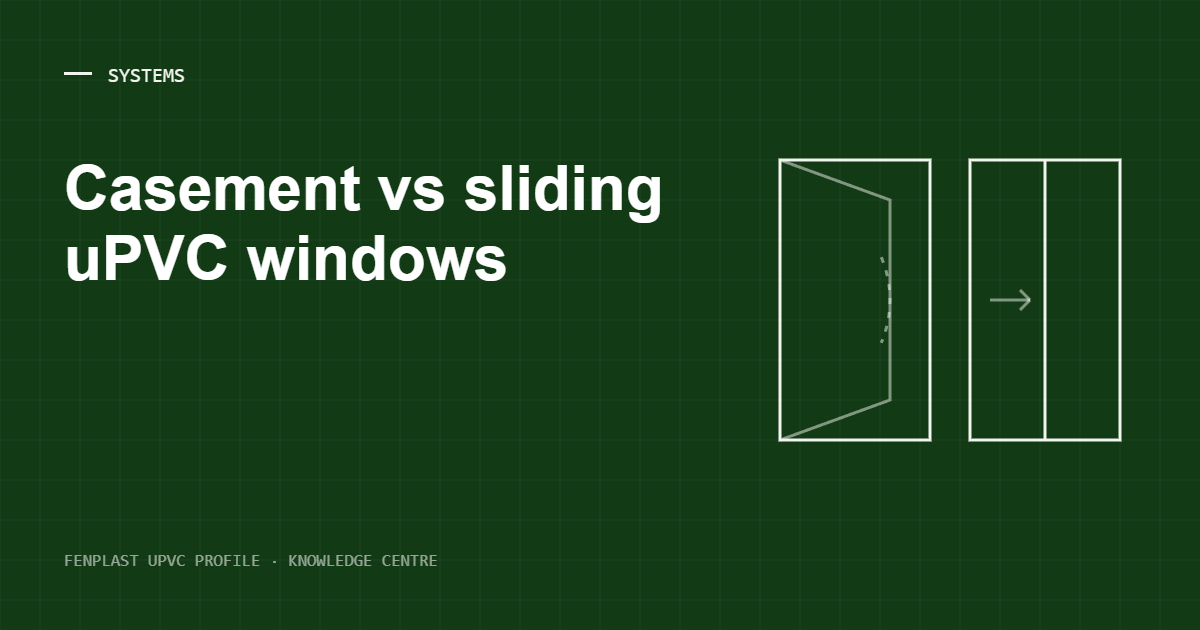
Sliding windows have shutters that move horizontally on tracks within the frame. Nothing projects into the room or outside the façade. Shutters meet at an interlock in the centre.
Casement windows are hinged at the side (or top, for awning windows) and swing open, outward or inward. When closed, a multi-point lock pulls the sash tight against gaskets around its full perimeter.
Head-to-head comparison
| Factor | Casement | Sliding |
|---|---|---|
| Air & water tightness | Excellent — compression gaskets | Good — interlock and brush seals |
| Sound insulation | Better, especially with DGU | Good with DGU |
| Ventilation area | Near-full opening | ≈ 50% (2 track), ≈ 67% (3 track) |
| Space needed to open | Swing clearance required | None |
| Works behind fixed grill | Inward-opening only | Yes |
| Mosquito mesh | Separate mesh frame | Integrated (2.5 / 3 track) |
| Security | Multi-point locking | Good with proper locks |
| Cleaning outer glass | Easy for inward-opening | Shutters can be lifted out |
| Typical cost | Higher | Lower |
Sealing: why casements win in exposed locations
In a sliding window, shutters must move freely, so seals are designed to brush rather than compress. A good interlock and correct drainage keep water out in normal rain, but in wind-driven monsoon rain on a high floor, some air and water pressure can get past brush seals.
A casement sash, by contrast, is pulled tight against a continuous gasket by the lock. Pressure from wind actually pushes an outward-opening sash harder onto its seals. That's why architects specify casements on sea-facing elevations, high-rise towers and bedrooms facing busy roads.
Space and grills: why sliders win in Indian apartments
Many Indian homes have fixed security grills outside windows, chajjas above them, or furniture below them. An outward casement can't open through a grill; an inward casement needs clear space inside. A slider needs neither, which is why it dominates apartment construction.
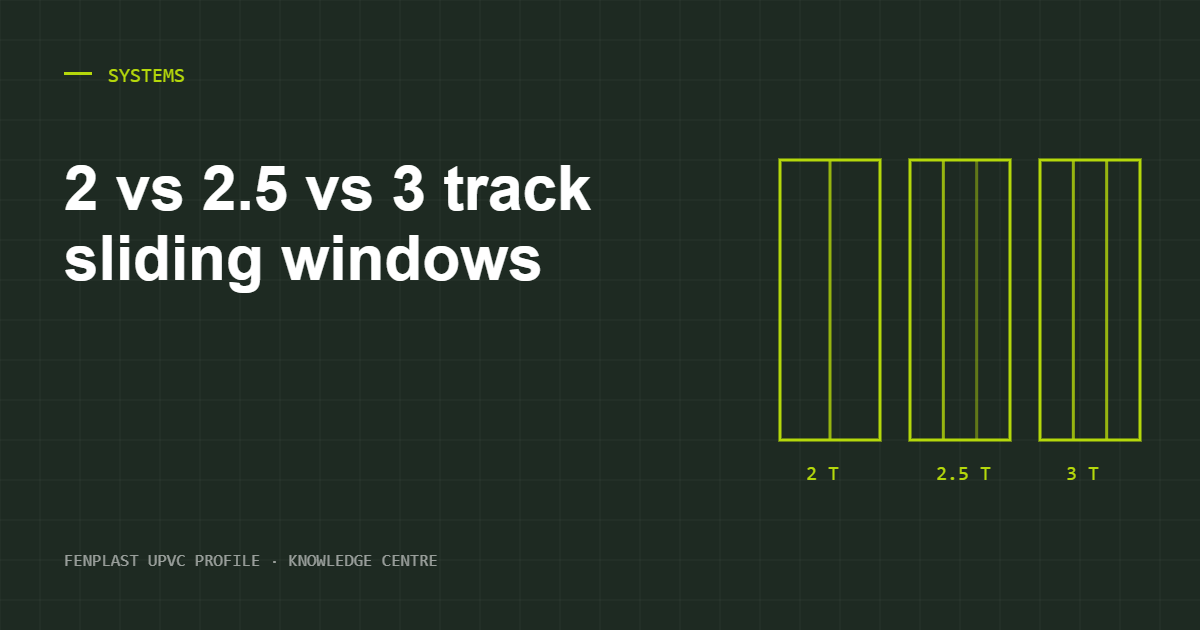
Sliders also handle mosquito mesh neatly. A 2.5 track window carries a mesh shutter on its own track, so families can sleep with the glass open.
Ventilation and comfort
A casement opened fully gives nearly the entire window area for airflow and can be angled to catch breeze — useful in Chennai's sea breeze afternoons. A two-track slider gives half. If cross-ventilation is a priority and there's no grill, casements are the better choice.
Noise
Both systems can take double glazing — FEN-AO-016 for casements and FEN-AO-017 for sliders. The Fenplast brochure cites sound reduction of up to 30 dB with double glass units. Because casements seal tighter, they generally deliver more of the glass's acoustic performance. For bedrooms facing highways, metro lines or flight paths, choose casement with double glazing.
Security
Casements use multi-point locks engaging along the sash edge, which is very secure. Sliders depend on the quality of their lock and the stiffness of the interlock; good hardware and steel reinforcement make them secure for most homes.
Cost
Casements cost more mainly because of hardware — hinges or friction stays, handles, multi-point locks and gasket runs. Profile cost is comparable. If budget is tight across a whole project, a common approach is casements on exposed elevations and sliders elsewhere.
Room-by-room recommendations
| Room / condition | Recommendation |
|---|---|
| Bedroom with grill | 2.5 track slider with mesh |
| Bedroom on busy road | Casement with double glazing |
| Living room with view | Casement with fixed glass |
| Kitchen | 2 track slider |
| Bathroom | Ventilator |
| High-rise / sea-facing | Casement |
| Balcony | Sliding door |
Inward or outward casement?
Outward-opening is standard in India and gives the best seal under wind pressure. Inward-opening (Fenplast FEN-CIS-012(B)) is ideal behind external grills and for cleaning glass safely from inside on upper floors. Both use the same casement frame.
Maintenance
Both need very little: wipe frames with soap and water, keep tracks or gasket faces clean, and check hardware once or twice a year. Sliders need tracks cleared of dust and drainage holes kept open; casements need hinges and locks lightly lubricated.
Our recommendation
There's no universal winner. Decide room by room. If in doubt, a fabricator using the Fenplast range can quote both from the same profile family — and our technical desk is happy to help with specific elevations.
Hardware: where casements earn their cost
The performance of a casement window depends heavily on hardware. Typical components include hinges or friction stays (which hold the sash open at an angle), a handle, a multi-point locking mechanism and keeps on the frame. Friction stays with restrictors are important on upper floors — they limit how far the sash opens for safety and stop it slamming in wind.
Sliding windows need rollers, a lock (often a crescent or multi-point lock), and guides. Good stainless rollers make a big difference to how a slider feels after a few years.
Combining both in one project
You don't have to choose one type for an entire building. A common, cost-effective approach in Chennai apartments:
- Casement or casement-with-fixed on sea-facing or road-facing elevations
- 2.5 track sliders in bedrooms on sheltered elevations
- 2 track sliders in kitchens and utility areas
- Sliding doors to balconies
- Ventilators in bathrooms
Because Fenplast casement and sliding profiles share the same compound, colour and finish, mixing systems on one façade looks consistent.
Casement window types explained
| Type | How it opens | Typical use |
|---|---|---|
| Side-hung outward | Hinged at side, swings out | Most common casement in India |
| Side-hung inward | Hinged at side, swings in | Behind grills, high floors |
| Top-hung (awning) | Hinged at top, opens out at bottom | Ventilation during light rain |
| Fixed + casement | Part fixed, part opening | Living rooms with views |
What fabricators should tell customers
Customers often choose based on what a neighbour has. A good fabricator explains the trade-offs: sealing and ventilation versus space and mesh. Show both on a sample, open them, and let the customer feel the difference in how they close. That five-minute demonstration avoids most post-installation disappointment.
Energy and air-conditioning
In an air-conditioned room, air leakage around the window is a direct energy loss. Because casements compress onto gaskets, they typically leak less air than sliders. For bedrooms and offices that run AC for many hours a day, that difference can show up on electricity bills over the years. Pair either system with double glazing and solar-control glass on sun-facing elevations for the best results.
Children and safety
For homes with small children on upper floors, consider sliders with locks out of reach, or casements with opening restrictors. Inward-opening casements let parents clean outer glass without leaning out. Whatever you choose, ask your fabricator about child-safety locks and restrictors.
Decision checklist
- Is there a fixed grill outside? → Slider or inward casement
- Is the elevation exposed to strong wind or sea? → Casement
- Do you need mosquito mesh? → 2.5 or 3 track slider
- Is noise a concern? → Casement with double glazing
- Is inside space tight? → Slider
- Is budget the main driver? → Slider
Still unsure? Send us your elevation and room list and our team will suggest a mix.
Frequently asked questions
Which is more airtight, casement or sliding?
Casement. The sash presses against continuous gaskets when locked, while sliding shutters rely on brush seals and interlocks.
Which gives more ventilation?
A casement opens almost the full sash area; a 2 track slider opens about half.
Can casement windows have mosquito mesh?
Yes, using a separate fixed or hinged mesh frame, but sliders with a mesh track are simpler.
Are casement windows safe on high floors?
Yes, with restrictor stays. Inward-opening casements also allow safe cleaning from inside.
Which costs more?
Casements usually cost more because of hinges, multi-point locks and gaskets.